
The Derby Effect: Does Rivalry Really Change EuroLeague Basketball?
Two cities. Four bitter rivals. One surprisingly similar pattern.
Olympiacos against Panathinaikos. Partizan against Crvena Zvezda. These are not ordinary basketball games. But if we want to find a real derby effect, comparing them with every EuroLeague game is not enough.
A derby often brings together strong teams. So we made the comparison tougher: derby games versus EuroLeague games between teams of a similar level.
A Fairer Comparison
For this analysis, similar-level games are games in which the two teams finished the season within 10 percentage points of each other in win percentage. The idea is simple: compare derbies with games that already feature relatively evenly matched opponents.
| Metric | Greek Derby | Belgrade Derby | Similar-Level Games |
|---|---|---|---|
| Total Points | 160.6 | 159.5 | 160.8 |
| Winning Margin | 9.7 | 5.8 | 9.9 |
| Turnovers | 24.9 | 26.6 | 24.6 |
| Fouls | 42.3 | 42.5 | 41.5 |
| Offensive Rebounds | 21.4 | 23.2 | 20.8 |
| Assists | 32.8 | 32.2 | 34.4 |
| FG% | 46.4% | 46.8% | 46.6% |
| 3PT% | 34.9% | 33.6% | 36.1% |
So Are Derbies Actually Closer?
Not necessarily. The Greek derby had an average winning margin of 9.7 points, almost identical to the 9.8 points in games between similarly matched teams.
Belgrade is different. Partizan versus Crvena Zvezda produced an average margin of only 5.8 points. That rivalry has been particularly tight, but closeness is not the most consistent derby signal across both cities.
The More Interesting Pattern Is How They Play
When we look beyond the final score, the two rivalries start to resemble each other.
Both produced fewer assists and lower three-point percentages than comparable EuroLeague games. Both also produced more offensive rebounds and slightly more fouls.
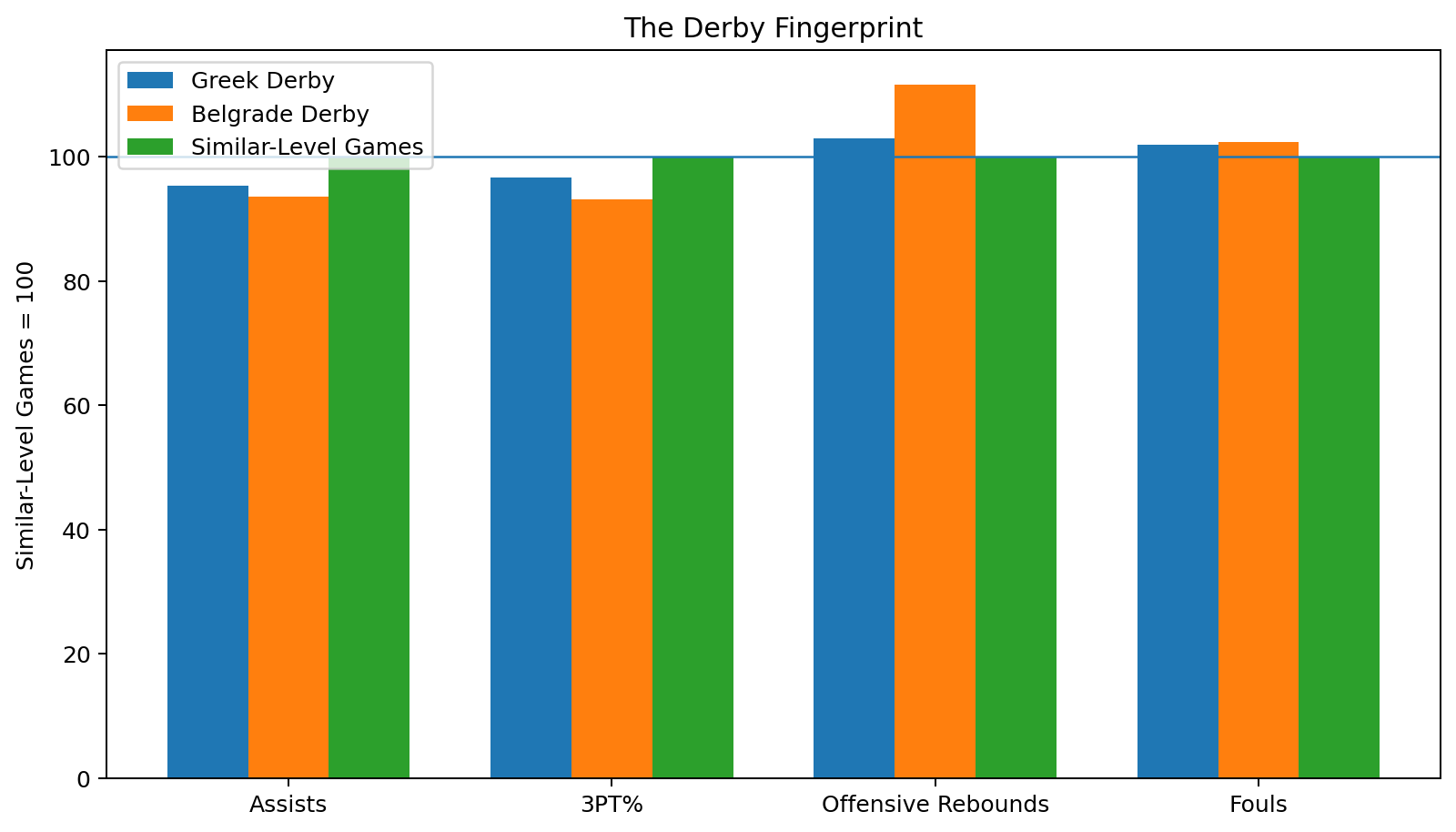
Fewer assists can suggest that clean offensive execution becomes harder. Lower three-point percentages fit a game with more pressure and contested possessions. More offensive rebounds suggest more fighting for second chances, while the foul numbers point toward slightly more physical basketball.
That does not prove rivalry causes these differences. Derby samples are naturally small, and the analysis is descriptive. But seeing the same direction in two separate rivalries makes the pattern worth watching.
What Could We Expect From the Istanbul Derby?
That brings us to another major rivalry: Fenerbahçe vs Beşiktaş.
If Istanbul follows the same pattern we found in Athens and Belgrade, the most interesting things to watch are not simply the final score or the winning margin.
- Assists: Does ball movement fall as familiar opponents make offensive execution harder?
- Three-point shooting: Does efficiency from outside drop under derby pressure?
- Offensive rebounds: Do we see more second-chance possessions?
- Fouls: Does the game become more physical?
We should not automatically expect a lower-scoring or closer game. Our comparison with similarly matched teams does not show that consistently.
The real question is whether Istanbul produces the same statistical fingerprint as Athens and Belgrade.
The Takeaway
Rivalry does not appear to completely rewrite basketball. But in Athens and Belgrade, several details move in the same direction: fewer assists, weaker three-point shooting, more offensive rebounding and slightly more fouls.
Maybe the Derby Effect is simple: the game is not necessarily closer, but every possession becomes a little harder.
Based on EuroLeague games since 2014. Similar-level games are defined here as games between teams whose season win percentages differ by no more than 10 percentage points. Results are descriptive and should not be interpreted as proof of causation.